Item
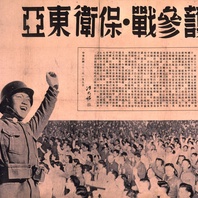
Yonghu canzhan, baowei Dong Ya (Support the declaration of war; defend East Asia)
Poster of Chinese soldier celebrating the declaration of war on the Allies by RNG China. The poster reads “Yonghu canzhan, baowei Dong Ya” (Support the declaration of war; defend East Asia), and includes the text of Wang Jingwei’s declaration of war on the Allies on 9 January 1943. Note that some postwar owner of this poster has written “wei guomin zhengfu” (bogus National Government) to the right of the text by Wang Jingwei so as to clarify which Chinese administration was declaring war on this occasion.
Read More
Item
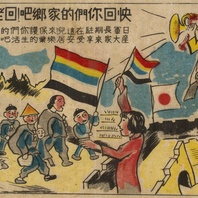
Kuai hui nimen de jiaxiang ba! (Hurry back to your homes!)
This leaflet, produced with the aim of encouraging civilians in occupied north China to return to cities and towns under Japanese rule, includes many of the standard tropes of early occupied north China propaganda: a “new woman”; city walls; the “five-coloured flag” (wuseqi). The text on the leaflet reads: “Hurry back to your homes! Return to your hometowns! The Japanese army will be here for a long time. Come and protect your livelihoods and your assets. Everyone can savour living in peace and enjoying their work again”.
Read More
Item
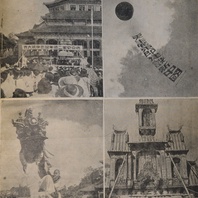
Celebratory ceremony marking the second anniversary of Guangdong’s ‘rebirth’
This series of photographs is taken from Huanan huabao (South China graphic) 2.6 (1940), and shows celebrations to mark the second anniversary of what the Japanese referred to as the “rebirth” of Guangzhou (i.e., the fall of Guangzhou) in October 1938. Note the prominence given to the Sun Yat-sen Memorial Hall, as well as the use of “folk” forms of cultural expression.
Read More
Item
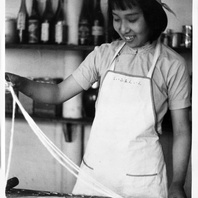
Noodle cooking
From a collection of staged photographs produced under the title “Life at a Girls School in Peking”, and produced at the Peking Jiyu Gakuen in Japanese-occupied Beijing. The original caption reads: “A girl is pulling noodles according to a Chinese style instead of cutting smaller [sic]”.
Read More
Item
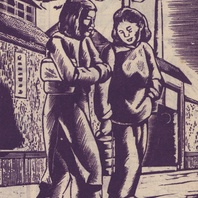
Shang gong (Off to work)
This woodcut, by an artist called Gu Yihua, was reproduced in Zhonghua huabao (Chinese Pictorial) 1.4 (November 1943). The importance of the muke (woodcut) form to artistic practice in occupied China has been almost entirely overlooked in the literature. The muke form has hitherto been almost exclusively associated with the art of resistance in China, despite being an important part of “occupation” visual cultures throughout the war.
Read More
Item
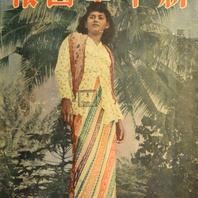
Xin Zhonghua huabao (New China Pictorial) cover, July 1943
This cover image from the Xin Zhonghua huabao (New China Pictorial) 5.7 (July 1943) shows a colourised photograph of an unnamed woman, probably from Malaya. The New China Pictorial was a bilingual (Chinese-English) magazine published from 1939 through 1944 in Shanghai by the occupation journalist Wu Linzhi for distribution in China and throughout Southeast Asia. This magazine employed cover images of women from areas of Southeast Asia that had been conquered by Japan with increasing regularity over the course of 1943 and 1944, having previously focused on Chinese film celebrities.
Read More
Item
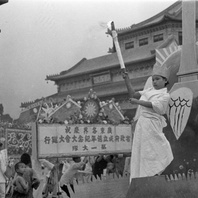
Untitled (Boy dressed as angel of peace)
A boy is dressed as the “angel of peace” and rides on a float during celebrations marking the first anniversary of the founding of the Guangdong Provincial Government under Wang Jingwei in May 1941. The building in the background is the city’s Sun Yat-sen Memorial Hall (Zhongshan jiniantang).
Read More
Item
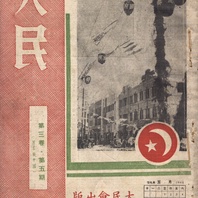
《大民》封面影像,1940年5月
這是大民會出版《大民》雜誌3.3的封面影像(1940年5月),由大民會於南京出版。大民會出版是1938年由日本創辦的宣傳和動員組織,後併入汪精衛的國民黨。大民會專精於公開支持日本佔領中國,並且雇用了中國的籌畫人、藝術家、以及作家。大民會雜誌的封面可見大民會的日月會徽。
Read More
Item
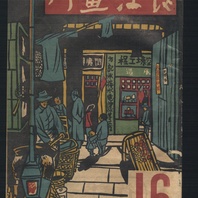
Changjiang huakan (Yangtze Pictorial) cover, January 1945
This cover image is taken from Changjiang huakan (Yangtse Pictorial) 16 (January 1945), a Wuhan-based pictorial. The image was by Noa Miura, a prolific Japanese illustrator attached to the Japanese military’s Press Corps (Hōdōbu), and a founding member of the official China Cartoon Association (Zhongguo Manhua Xiehui) in occupied China.
Read More
Featured Item
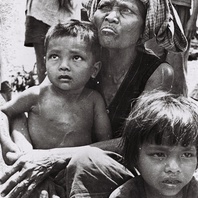
A woman and children (survivors), Cambodia
This photograph is part of the collection held by the Agence Khmère de Presse (AKP) and Cambodia’s Ministry of Information. This collection, which documents the early years of the People’s Republic of Kampuchea as photographed by the Vietnamese and a small team of Cambodian photographers, has not yet been classified or indexed.
Read More
Item
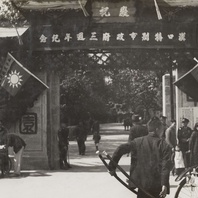
武漢的公園,1943年春天
相片中為一座位於武漢的公園,「慶祝漢口特別市政府三周年紀念」。然而,武漢經常以戰爭初期抗日中心為名,更曾經於1940年納入汪精衛政府麾下,成為該政權主要的政治及文化中心。