Item
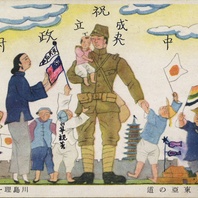
Kagayaku Tōa no michi (The road to a shining East Asia)
This postcard, featuring an illustration by the prolific Japanese artist Riichiro Kawashima, shows a Japanese soldier celebrating “kagayaku Tōa no michi” (the road to a shining East Asia), with Chinese civilians. Of interest here is the fact that the Republican Chinese flag appears to have been drawn onto the postcard (and made to look as if it is being held by the child dressed in white), while other figures in the image hold the “five-coloured flag (wuseqi). The “five-coloured flag” was used by the Reformed Government of the Republic of China (RGROC) up until March 1940, but was replaced by the Republican Chinese flag with the formation of Wang Jingwei’s government. This suggests that the postcard was made prior to March 1940, but used some time thereafter. Text reading “qing zhu xin zhongyang zhengfu chengli” (Celebrating the founding of the new central government) has also been added above the figures, while the phrase “Ri-Hua qinshan” (Japanese-Chinese friendship) has been added to the boy in white.
Read More
Item
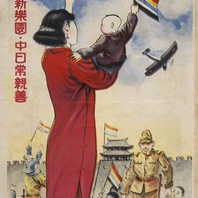
Ertong xin leyuan, Zhong-Ri chang qinshan (New paradise for children; China and Japan will forever be close)
This poster, almost certainly produced with the aim of encouraging civilians in occupied Beijing to embrace Japanese rule, includes many of the standard tropes of early occupied north China propaganda: a “new woman” with a male child; city walls; Japanese soldiers fraternising with Chinese infants; the “five-coloured flag” (wuseqi); and a sky filled with Japanese airplanes.
Read More
Item
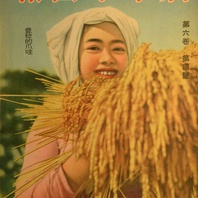
Xin Zhonghua huabao (New China Pictorial) cover, April 1944
This cover from the Xin Zhonghua huabao (New China Pictorial) 6.4 (April 1944) shows an image of an unnamed Javanese woman harvesting rice. Harvesting had been a common theme of propaganda in areas conquered by the Japanese (including Manchukuo and China) since at least the early 1930s. The New China Pictorial was a bilingual (Chinese-English) magazine published from 1939 through 1944 in Shanghai by the occupation journalist Wu Linzhi for distribution in China and throughout Southeast Asia. This magazine employed cover images of women from areas of Southeast Asia that had been occupied by Japan with increasing regularity over the course of 1943 and 1944, having previously focused on Chinese film celebrities.
Read More
Item
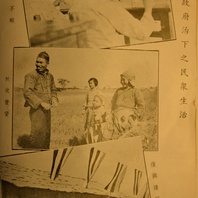
維新政府治下之民眾生活
這一系列未註明出處的相片出自大民會所出版的《新中國》3.1(1940年1月)。這些照片用於呈現1938年成立的屬國政權─維新政府統治下的生活,而其最終於1940年3月併入汪精衛國民政府。最頂端的圖片標題為「絃歌不輟」;中間的圖片標題為「秋收豐登」;最底部的圖片標題為「復興建築」。這三張相片均是大民會於1938年至1940年期間所提倡最典型的影像,但同時也展現1930年代初期滿州國宣傳照片的深遠影響。
Read More
Item
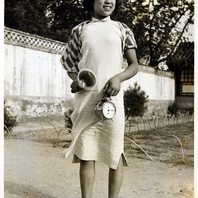
「偉大的家庭主婦」手持學校的鈴鐺
本照片取自一系列經過事先安排的照片,標題為「北京女子學校的生活」,拍攝地點位於日佔北京的北京自由學園。原本的標題寫道:「女生必須每天以『偉大的家庭主婦』為題輪流拿著鈴鐺。中國女生沒有時間的概念,但她們知道早晨、中午、以及晚上。教導時間概念是邁向更好教育基礎的第一步」。
Read More
Item
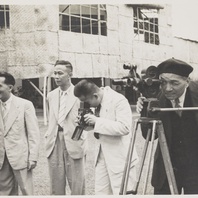
褚民誼使用電影攝影機
這張尚未標註日期的相片中,汪精衛國民政府外長褚民誼嘗試電影製作。在他身旁的(可能)為中央社攝影師陳國琦。汪精衛國民政府宣傳部長林柏生位於相片中最左邊。這張照片是在1940年夏天由褚民誼拍攝由汪精衛所召集的內閣會議時拍攝的。該事件的新聞影片可在此處找到。
Read More
Item
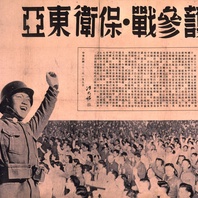
擁護參戰、保衛東亞
海報描繪中國士兵慶祝汪精衛南京政府向盟軍宣戰。海報上寫著:「擁護參戰、保護東亞!」當中也包含了1943年1月9日,汪精衛向盟軍宣戰的文字。特別值得一提的是,此海報的某些戰後的物主在汪精衛的文字右邊寫下:「偽國民政府」,以便釐清當下宣戰之中國政權為何。
Read More
Featured Item
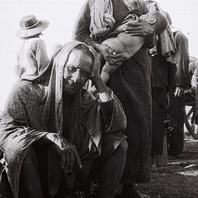
Group of villagers (survivors), Cambodia
This photograph is part of the collection held by the Agence Khmère de Presse (AKP) and the Ministry of Information of Cambodia. This collection, which documents the early years of the People’s Republic of Kampuchea as photographed by the Vietnamese and a small team of Cambodian photographers, has not yet been classified or indexed.
Read More
Featured Item
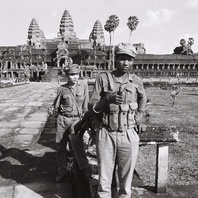
Soldiers at Angkor Wat
This image shows two soldiers of the Kampuchea United Front for National Salvation (KUFNS, also known as FUNSK) [Front or Renakse] posing in front of Angkor Wat. This photograph is part of the collection held by the Agence Khmère de Presse (AKP) and Cambodia’s Ministry of Information. This collection, which documents the early years of the People’s Republic of Kampuchea as photographed by the Vietnamese and a small team of Cambodian photographers, has not yet been classified or indexed.
Read More
Featured Item
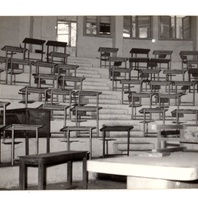
Empty lecture hall
This photograph is part of the collection held by the Agence Khmère de Presse (AKP) and Cambodia’s Ministry of Information. This collection, which documents the early years of the People’s Republic of Kampuchea as photographed by the Vietnamese and a small team of Cambodian photographers, has not yet been classified or indexed.
Read More
Item
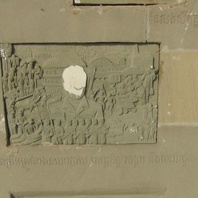
Win-Win Monument carving
This photograph shows a small carving on the 117-metre-long engraved base of the Win-Win Monument. The the central figure in the carving (possibly Hun Sen) has been defaced. The Win-Win Monument complex – photographed here in January 2020 – was inaugurated in December 2018 to mark the twentieth anniversary of the end of the post-Democratic Kampuchea civil war, with the final defection of the remaining Khmer Rouge factions, thanks to the DIFID policy (“Divide, Isolate, Finish, Integrate, Develop”) also known as the “Win Win” policy of Prime Minister Hun Sen.
Read More
Item
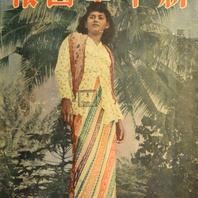
《新中華画報》封面,1943年7月
這張封面影像出自《新中華画報》5.7(1943年7月),呈現一位可能來自馬來亞的不知女子的彩色照片。《新中華画報》是雙語(中英)刊物,由日佔時期新聞工作者伍麟趾於1939年至1944年時期在上海出版,並發送至中國及東南亞地區。該雜誌於1943年至1944年期間日漸頻繁的採用日佔東南亞地區的女性為封面照片,而在此之前則聚焦於中國影視名人。