Item
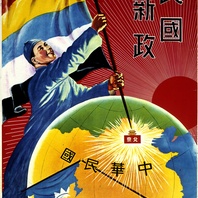
Minguo xinzheng (New government for the Republic)
This poster was almost certainly produced to coincide with the founding of the PGROC in December 1937. The visual trope of the rising sun and city gates of Beijing emitting light are clearly reminiscent of Manchukuo propaganda. Note also the references to a tattered Chinese Nationalist Party (KMT) flag, with its “white sun” emblem. The replacement of this flag with the “five coloured flag ” (wuseqi), which was revived by the PGROC in 1937, was indicative of a general approach under this administration to discredit Nationalist ideologies in favour of more conservative, Confucian ideas. Note also the rather ambitious designs that this regime had on the rest of China (the man is planting his flag on China as a whole, rather than the patchwork of territory in north China over which the PGROC actually ruled).
Read More
Item
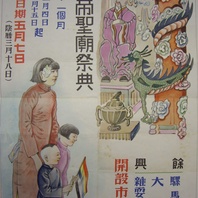
Yaodi shengmiao jidian (Ceremony at the Emperor Yao Temple)
This poster was produced (almost certainly by the Japanese military) with the aim of advertising the re-opening of the Emperor Yao Temple (Yaodi shengmiao) in Linfen (Shanxi Province). This site was taken by the Japanese from communist resistance fighters, and was used by the Japanese as a symbol of the apparent iconoclasm and lack of religious sensitivity shown by the communists. The re-opening the temple to worshippers in the spring of 1938 by the Japanese was used to demonstrate the extent to which occupation supposedly included respect for Chinese religious traditions. The painted image of the female worshipper here was based on a photograph of a female worshipper at the same temple produced in other propaganda leaflets some months earlier.
Read More
Item
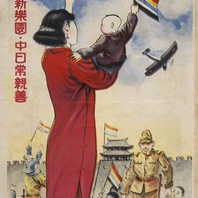
Ertong xin leyuan, Zhong-Ri chang qinshan (New paradise for children; China and Japan will forever be close)
This poster, almost certainly produced with the aim of encouraging civilians in occupied Beijing to embrace Japanese rule, includes many of the standard tropes of early occupied north China propaganda: a “new woman” with a male child; city walls; Japanese soldiers fraternising with Chinese infants; the “five-coloured flag” (wuseqi); and a sky filled with Japanese airplanes.
Read More
Item
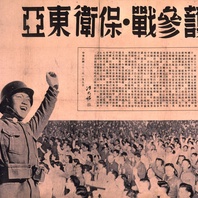
Yonghu canzhan, baowei Dong Ya (Support the declaration of war; defend East Asia)
Poster of Chinese soldier celebrating the declaration of war on the Allies by RNG China. The poster reads “Yonghu canzhan, baowei Dong Ya” (Support the declaration of war; defend East Asia), and includes the text of Wang Jingwei’s declaration of war on the Allies on 9 January 1943. Note that some postwar owner of this poster has written “wei guomin zhengfu” (bogus National Government) to the right of the text by Wang Jingwei so as to clarify which Chinese administration was declaring war on this occasion.