Featured Item
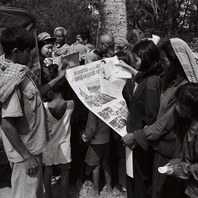
Villagers looking at a poster
This (probably staged) photograph shows a group of villagers looking at an illustrated poster about the Kampuchea United Front for National Salvation (KUFNS, also known as FUNSK) [Front or Renakse]. It is part of a series that describes the same group of villagers and soldiers. This photograph is part of the collection held by the Agence Khmère de Presse (AKP) and Cambodia’s Ministry of Information. This collection, which documents the early years of the People’s Republic of Kampuchea as photographed by the Vietnamese and a small team of Cambodian photographers, has not yet been classified or indexed.
Read More
Featured Item
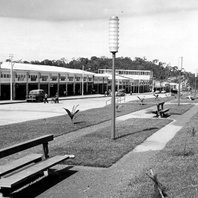
Commercial street in Sihanoukville
This unattributed photograph shows a commercial street in Sihanoukville town centre in the mid 1960s, with one side of the street having a promenade with benches and lampposts, and shops on the opposite side, under an arcade. The photograph is part of the collection that was donated to the National Archives of Cambodia from the Library of the Royal University of Fine Arts by Darryl Collins and Helen Grant Ross in 2003. The collection was used by Collins and Ross for their research into urbanisation. The images were probably originally used to mount the Sangkum Reastr Niyum Permanent Exhibition at the Exhibition Hall, Bassac area, Phnom Penh.
Read More
Item
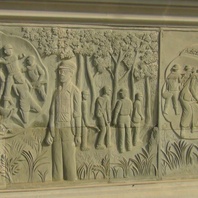
Win-Win Monument bas-relief
This photograph provides a view of bas-relief on the 117-metre-long engraved base of the Win-Win Monument. It depicts the defection to Vietnam of the then Khmer Rouge officer Hun Sen in June 1977. One sees Hun Sen (dressed in Khmer Rouge garb) considering what may happen to him and his group of defectors (being killed) if they are caught by the Khmer Rouge. It also shows Hun Sen thinking about his wife who he left behind. The Win-Win Monument complex – photographed here in January 2020 – was inaugurated in December 2018 to mark the twentieth anniversary of the end of the post-Democratic Kampuchea civil war, with the final defection of the remaining Khmer Rouge factions, thanks to the DIFID policy (“Divide, Isolate, Finish, Integrate, Develop”) also known as the “Win Win” policy of Prime Minister Hun Sen.
Read More
Featured Item
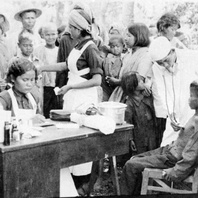
Medical team treating children
This unattributed photograph, showing a medical team treating children, was featured in the publication (French and English versions) entitled The People’s Republic of Kampuchea (1979). This photograph is part of the collection held by the Agence Khmère de Presse (AKP) and Cambodia’s Ministry of Information. This collection, which documents the early years of the People’s Republic of Kampuchea as photographed by the Vietnamese and a small team of Cambodian photographers, has not yet been classified or indexed.
Read More
Item
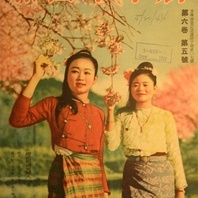
Xin Zhonghua huabao (New China Pictorial) cover, May 1944
This cover image from the Xin Zhonghua huabao (New China Pictorial) 6.5 (May 1944) shows a photograph of two unnamed Burmese women. The New China Pictorial was a bilingual (Chinese-English) magazine published from 1939 through 1944 in Shanghai by the occupation journalist Wu Linzhi for distribution in China and throughout Southeast Asia. This magazine employed cover images of women from areas of Southeast Asia that had been conquered by Japan with increasing regularity over the course of 1943 and 1944, having previously focused on Chinese film celebrities.
Read More
Item
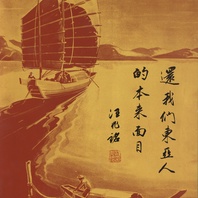
還我們東亞人本來的面目
這幅未署名的印刷物出自於1941年的一本特刊手冊,紀念當年6月汪精衛拜訪日本。「還我東亞人本來的面目」一段話是「還我河山」的一種文字遊戲。「還我河山」可能是戰時抗日宣傳中最常用的詞組。這印刷物出自黃慶樞所著之《汪主席訪日紀念畫刊》(南京:宣傳部,1941年)。
Read More
Item
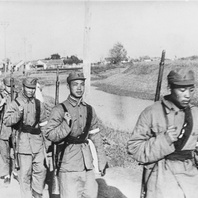
汪精衛國民政府軍隊行經河岸
一群汪精衛國民政府士兵行經不知名河岸。推測可能為清鄉活動的一部分。
Read More
Item
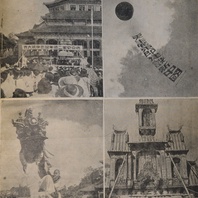
慶祝廣東更生二周年祝賀典禮
這一系列照片出自《華南畫報》2.3(1940年),當中呈現了日本人稱之為廣州於1938年的更生(即廣州的失守淪陷)二周年紀念祝賀典禮。值得注意的是其中中山紀念堂的重要性,以及當中「民間」形式的文化展現。
Read More
Item
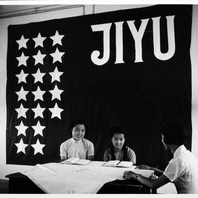
一名年輕的日本老師以日文教學
本照片取自一系列經過事先安排的照片,標題為「北京女子學校的生活」,拍攝地點位於日佔北京的北京自由學園。原本的標題寫道:「這位老師才20幾歲初頭」。
Read More
Item
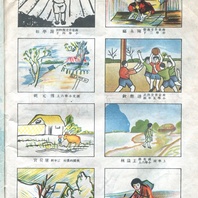
Ertong zuopin (works by children), II
This is a selection of images (most being pencil drawings) contributed to the magazine Ertong huakan (Children’s Pictorial) 9.10 (April 1941) by readers. The images offer a fascinating insight into the ways in which official ideas about the appearance of occupied China were reflected in the artwork of Chinese school children living in the RNG capital. Note the references to dawn, for example, the depictions of Japanese people, and the idyllic images of the Chinese countryside included in some of the drawings. Basketball remained a politically acceptable sport in occupied Nanjing despite its American provenance.
Read More
Item
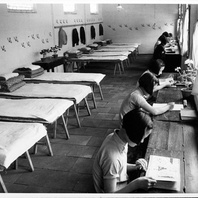
Girls are all living in a dormitory [sic]
From a collection of staged photographs produced under the title “Life at a Girls School in Peking”, and produced at the Peking Jiyu Gakuen in Japanese-occupied Beijing. The original caption reads: “They are doing their ‘home works’ [sic]”.
Read More
Item
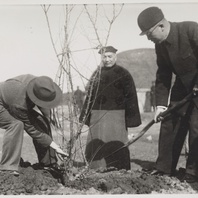
Planting plum trees at Wang Jingwei’s tomb
RNG foreign minister Chu Minyi oversees the planting of young plum trees on Meihuashan (Plum Blossom Mount) in Nanjing, in the vicinity of Wang Jingwei’s tomb. The plum was (and remains) the national flower of the Republic of China, and the area around Wang Jingwei’s tomb was planted with plums as an act of patriotism after his death in late 1944. Very few photographs of Wang’s tomb survive.