Item
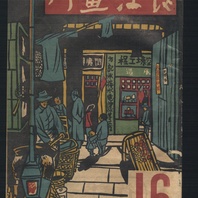
Changjiang huakan (Yangtze Pictorial) cover, January 1945
This cover image is taken from Changjiang huakan (Yangtse Pictorial) 16 (January 1945), a Wuhan-based pictorial. The image was by Noa Miura, a prolific Japanese illustrator attached to the Japanese military’s Press Corps (Hōdōbu), and a founding member of the official China Cartoon Association (Zhongguo Manhua Xiehui) in occupied China.
Read More
Featured Item
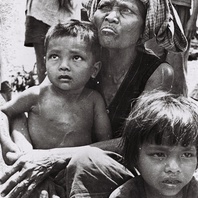
A woman and children (survivors), Cambodia
This photograph is part of the collection held by the Agence Khmère de Presse (AKP) and Cambodia’s Ministry of Information. This collection, which documents the early years of the People’s Republic of Kampuchea as photographed by the Vietnamese and a small team of Cambodian photographers, has not yet been classified or indexed.
Read More
Item
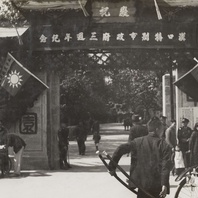
武漢的公園,1943年春天
相片中為一座位於武漢的公園,「慶祝漢口特別市政府三周年紀念」。然而,武漢經常以戰爭初期抗日中心為名,更曾經於1940年納入汪精衛政府麾下,成為該政權主要的政治及文化中心。
Read More
Featured Item
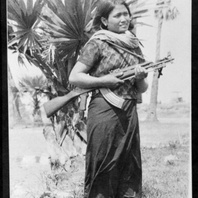
Female soldier of the Kampuchea United Front for National Salvation
This unattributed photograph shows a young Cambodian female soldier of the Kampuchea United Front for National Salvation (KUFNS, also known as FUNSK) [Front or Renakse]. She stands in front of a tree holding a rifle. She is not in uniform but wears a sarong (traditional lower garment). The image was featured in the publication (French and English versions) entitled The People’s Republic of Kampuchea (1979). This photograph is part of the collection held by the Agence Khmère de Presse (AKP) and Cambodia’s Ministry of Information. This collection, which documents the early years of the People’s Republic of Kampuchea as photographed by the Vietnamese and a small team of Cambodian photographers, has not yet been classified or indexed.
Read More
Featured Item
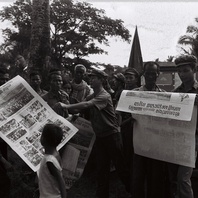
Soldiers distributing posters to villagers
This (probably staged) photograph shows soldiers distributing illustrated posters about the Kampuchea United Front for National Salvation (KUFNS, also known as FUNSK) [Front or Renakse] to a group of villagers. This photograph is part of the collection held by the Agence Khmère de Presse (AKP) and Cambodia’s Ministry of Information. This collection, which documents the early years of the People’s Republic of Kampuchea as photographed by the Vietnamese and a small team of Cambodian photographers, has not yet been classified or indexed.
Read More
Featured Item
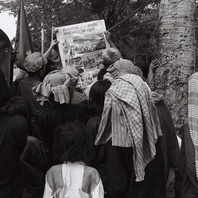
Villagers looking at a poster
This (probably staged) photograph shows a group of soldiers and villagers looking at an illustrated poster about the Kampuchea United Front for National Salvation (KUFNS, also known as FUNSK) [Front or Renakse]. It is part of a series that describes the same group of villagers and soldiers. This photograph is part of the collection held by the Agence Khmère de Presse (AKP) and Cambodia’s Ministry of Information. This collection, which documents the early years of the People’s Republic of Kampuchea as photographed by the Vietnamese and a small team of Cambodian photographers, has not yet been classified or indexed.
Read More
Item
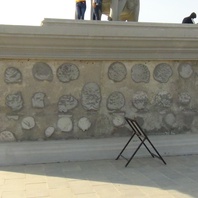
Win-Win Monument base
This photograph depicts an empty section of the 117-metre-long engraved base of the Win-Win Monument. There are traces that show some work has been done on the base but subsequently removed. The Win-Win Monument complex – photographed here in January 2020 – was inaugurated in December 2018 to mark the twentieth anniversary of the end of the post-Democratic Kampuchea civil war, with the final defection of the remaining Khmer Rouge factions, thanks to the DIFID policy (“Divide, Isolate, Finish, Integrate, Develop”) also known as the “Win Win” policy of Prime Minister Hun Sen.
Read More

Item
Win-Win Monument bas-relief
This photograph provides a view of bas-relief on the 117-metre-long engraved base of the Win-Win Monument. It depicts scenes from the 1970-1975 civil war, with Marshal Lon Nol giving a speech, military vehicles and weapons, and Hun Sen at the centre of the bas-relief. The Win-Win Monument complex – photographed here in January 2020 – was inaugurated in December 2018 to mark the twentieth anniversary of the end of the post-Democratic Kampuchea civil war, with the final defection of the remaining Khmer Rouge factions, thanks to the DIFID policy (“Divide, Isolate, Finish, Integrate, Develop”) also known as the “Win Win” policy of Prime Minister Hun Sen.