Item
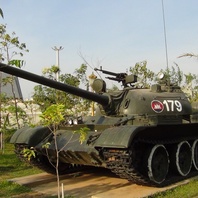
Soviet-era tank, Win-Win Monument
This photograph shows an armoured tank on display on the southern side of the Win-Win Monument complex. The Win-Win Monument complex – photographed here in January 2020 – was inaugurated in December 2018 to mark the twentieth anniversary of the end of the post-Democratic Kampuchea civil war, with the final defection of the remaining Khmer Rouge factions, thanks to the DIFID policy (“Divide, Isolate, Finish, Integrate, Develop”) also known as the “Win Win” policy of Prime Minister Hun Sen.
Read More
Item
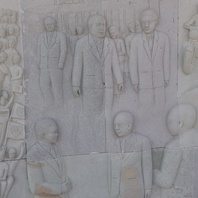
Win-Win Monument bas-relief
This photograph shows a detail of the UNTAC -themed bas-relief on the 117-metre-long engraved base of the Win-Win Monument. It focuses on the Paris Peace Agreements (October 1991),and the (unofficial) meeting between Prince Norodom Sihanouk and Hun Sen. The Win-Win Monument complex – photographed here in January 2020 – was inaugurated in December 2018 to mark the twentieth anniversary of the end of the post-Democratic Kampuchea civil war, with the final defection of the remaining Khmer Rouge factions, thanks to the DIFID policy (“Divide, Isolate, Finish, Integrate, Develop”) also known as the “Win Win” policy of Prime Minister Hun Sen.
Read More
Item
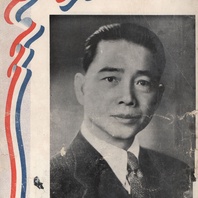
H. E. Mr Wang Ching-wei
This supplement was published by the Ministry of Publicity (Xuanchuanbu) on the very day that Wang Jingwei officially “returned” to Nanjing to take up the reins of government under Japanese occupation. The symbols attached to this image (e.g., the KMT “white sun” ensign, and the colours of the ROC flag) suggest a “return” to pre-war norms. The presence of the Japanese is not so much as mentioned here.
Read More
Item
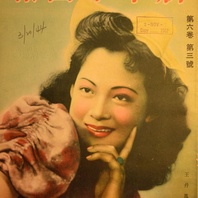
Xin Zhonghua huabao (New China Pictorial) cover, March 1944
This cover image from the Xin Zhonghua huabao (New China Pictorial) 6.3 (March 1944) shows a colourised photograph of Wang Danfeng. Wang was a popular film celebrity in wartime Shanghai. The New China Pictorial was a bilingual (Chinese-English) magazine published from 1939 through 1944 in Shanghai by the occupation journalist Wu Linzhi for distribution in China and throughout Southeast Asia.
Read More
Item
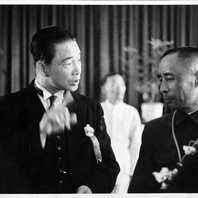
Wang Jingwei with Zang Shiyi
Zang Shiyi (right), the Manchukuo ambassador to the RNG, speaks to Wang Jingwei prior to the both men signing the Japan-Manchukuo-China Joint Declaration on 30 November 1940, through which RNG China recognised Manchukuo. The Declaration was attached to the Sino-Japanese Basic Treaty, through which Japan formally recognised the RNG. Both documents were signed within the main RNG government compound in Nanjing.
Read More
Item
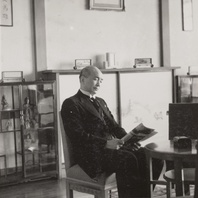
Chu Minyi in his office
In this staged photograph, the RNG foreign minister Chu Minyi is pictured reading a magazine in his office, with a photographic portrait of Wang Jingwei on the wall behind his desk, and Buddhist objets d’art in a cabinet behind him.
Read More
Item
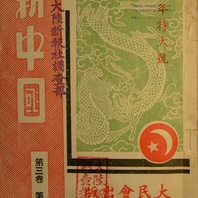
《新中國》的封面影像,1940年1月
這是大民會於南京出版的《新中國》3.1(1940年1月)。大民會為一個宣傳及動員組織,由日本於1938年成立,後併入汪精衛的國民黨。大民會專精於公開支持日本佔領中國,並且雇用了中國的籌畫人、藝術家、以及作家。大民會雜誌的封面可見大民會的日月會徽。
Read More
Item
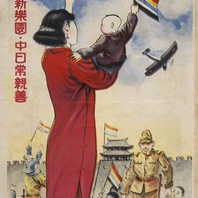
兒童新樂園,中日常親善
這幅海報的設計理念極可確定是為了鼓勵市民齊聚北京接受日本統治,其中包含了早期日佔華北宣傳的標準理念:一位「新女性」捧著一名男嬰、城牆、日本軍人與中國嬰兒表示友善、「五色旗」、天空充滿日本的飛機。
Read More
Item
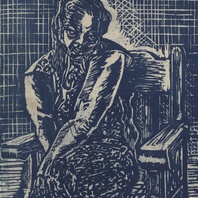
婦人像
這幅木刻畫出自馬午之手(可能為日佔時期受歡迎藝術家中作品最豐富的一位),於《中華畫報》2.2(1943年3月)重製。木刻畫對日據中國藝術的重要性在文學幾乎被全然忽視。木刻畫迄今幾乎特指中國反抗的藝術,儘管該風格屬於戰爭期間重要的「日據」視覺文化。
Read More
Item
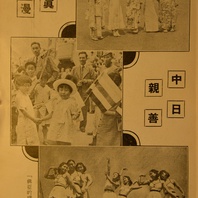
中日親善,天真爛漫
這一系列未註明出處的相片出自大民會所出版的《新中國》3.1(1940年1月)。這些照片用於呈現「中日友誼」。最上面兩張影像中,中國和日本的孩童互相問候,揮舞日本國旗和維新政府旗幟。最底部的影像則呈現一些不知名的舞者者表演名為「興亞的曙光」的「秋舞」。
Read More
Item
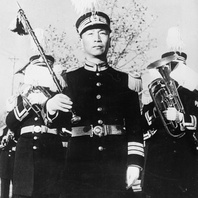
遊行樂隊指揮
相片中汪精衛國民政府軍隊銅管樂隊由遊行樂隊指揮帶領,在日佔南京之行政院前所攝。國民政府極度重視軍隊銅管樂隊。
Read More
Featured Item
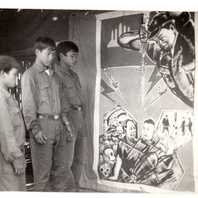
Three men looking at a propaganda poster
This picture shows three young male soldiers looking at a poster that represents a soldier of the Kampuchea United Front for National Salvation (KUFNS, also known as FUNSK) [Front or Renakse] aiming his rifle with bayonet at the enemies, Pol Pot and Ieng Sary. The drawing next to Pol Pot’s head is a reproduction of a photograph of killings by Khmer Rouge guards that were published between April 1976 and January 1978 in the mainstream Western media. Different stories circulated about the origin of those pictures. Some said they had been smuggled out of Cambodia by a relative of the photographer, who himself had died while trying to escape, or by a Cambodian refugee in Paris who refused to reveal his identity. According to Sygma Photo News (the agency which had distributed the original pictures), the images came from Khmer Rouge defectors. In fact, the photos had first appeared in a Thai newspaper in April 1976 and were reprinted in the Bangkok Post under the headline “True or false?” a few days later. The newspaper explained that they had first refused to buy the images from the Thai trader who tried to sell them because they had doubted their authenticity. Even American intelligence services thought the pictures were fake. The photographs, it turned out, were part of an operation by the Thai intelligence services. They had been staged and taken in Thailand. This photograph is part of the collection held by the Agence Khmère de Presse (AKP) and Cambodia’s Ministry of Information. This collection, which documents the early years of the People’s Republic of Kampuchea as photographed by the Vietnamese and a small team of Cambodian photographers, has not yet been classified or indexed.